Summer Wedding Guest Jewellery: How to Style Gemstone Pendants with Pastels
A seasonal guide to pairing gemstone pendants with pastel wedding guest outfits — choosing stones by...

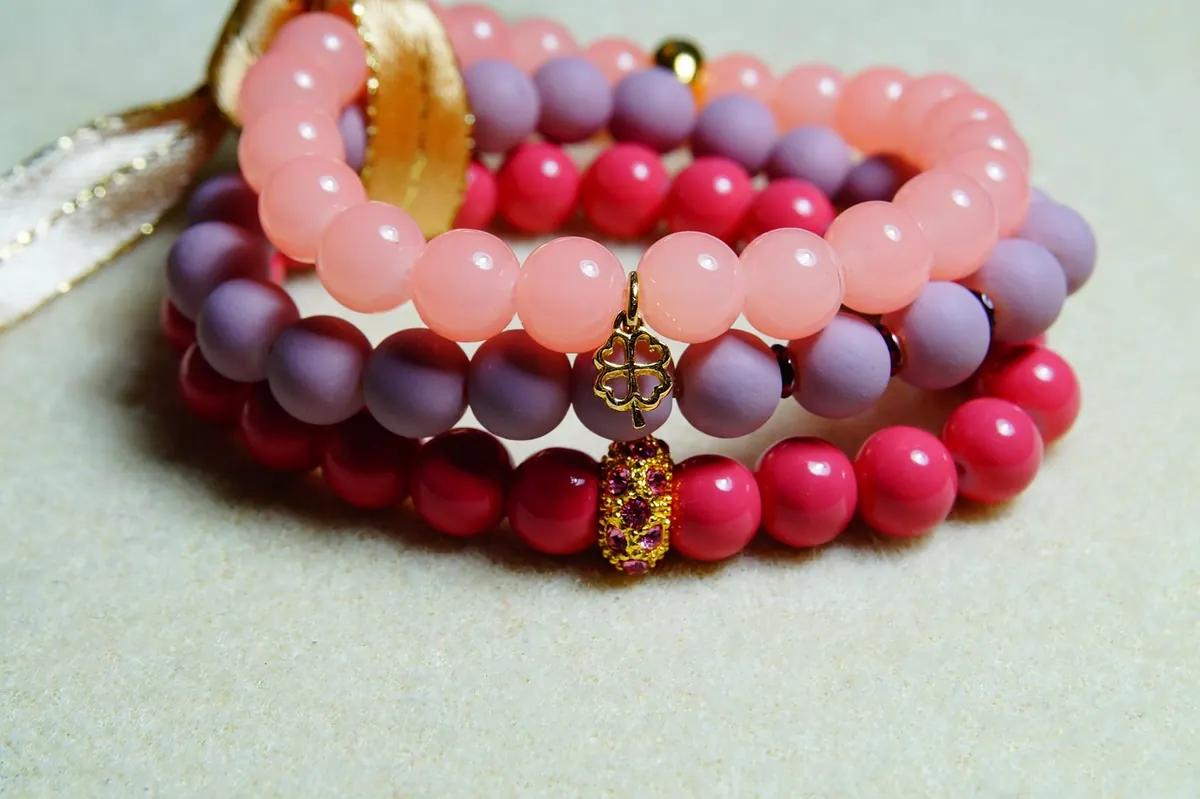
A well-stacked wrist looks as though it happened by accident. It almost never does. Most crowded wrists are built one bracelet at a time — a gift here, a holiday purchase there — until the arm rattles and nothing stands out. Layering gemstone bracelets is a skill, but it runs on a simple structure. Learn the rules below and you can build a balanced stack from pieces you already own.
Every stack needs one piece that sets the tone. Pick the bracelet you would happily wear on its own on a day when you cannot be bothered with decisions. That is your anchor. It is usually the boldest piece you own: an 8mm or 10mm beaded bracelet in a stone you never tire of, a wide cuff, or a chain with a bit of weight behind it.
Put the anchor on first, and place it where you want the eye to land. On most wrists that is just below the wrist bone, or right in the middle of the stack. Everything you add afterwards is a supporting act. If a bracelet does not sit comfortably next to the anchor, it does not go on — no matter how much you like it on its own.
Three bracelets is where a stack starts to read as deliberate rather than accidental, and it is the easiest number to balance. A reliable formula is one bold piece, one medium piece and one fine piece.
Once three works, add a fourth by keeping the same proportions in mind. If you add a second bold bracelet, take something else off. The stack should grow sideways, not pile up.
Size contrast does more work than colour. Two bracelets of the same bead size sitting side by side can look like a mistake, because the eye cannot tell which one to look at. A 10mm, a 6mm and a 4mm together look intentional. If you own two bracelets in the same stone, that difference in scale is often all you need.
Shape matters too. Round beads, faceted beads, chips and cubes all read differently on the wrist. A faceted stone catches the light; a smooth one softens it. Pairing the two creates movement without adding any more colour.
Bracelets need room to move. If every piece is jammed against the next, the stack becomes one solid mass, and harder stones can dull the surface of softer ones over time. Try a fine bracelet, a small gap, then the two heavier pieces. That breathing space is what separates a stack from a pile.
Decide on a scheme before you choose bracelets, then work within it. Three approaches cover most wrists.
Stay in one family and vary the depth: rose quartz, rhodonite and garnet give you pale pink through to deep red. Amethyst, charoite and sodalite do the same job in purple and blue.
Choose stones that sit next to each other on the colour wheel. Citrine, tiger's eye and carnelian make a warm, honeyed group. Green aventurine, prehnite and aquamarine create a cooler one.
Keep most of the stack quiet — clear quartz, smoky quartz, howlite, a neutral cord — and let a single coloured bracelet do the talking. One vivid stone against a calm group stands out far more than five competing ones.
Metal is a colour as well. Silver, white gold and steel read cool; gold, brass and bronze read warm. Mixing them works when it is clearly a choice, so keep the proportions uneven — two cool pieces and one warm, rather than an even split.
Two bracelets in the same colour but different finishes look far more considered than two in different colours with the same finish. Polished beads bounce light; matte and frosted beads absorb it. Put a glossy black onyx next to a matte grey stone and the contrast does the work for you.
Texture also comes from materials. A beaded bracelet, a fine chain and a knotted cord bracelet in one stack give three different rhythms to the same wrist. Add spacers or a single charm where you want a small pause, and keep them to one or two so they stay punctuation rather than noise.
Add one, take one away. If a new bracelet does not improve the whole stack, it is not ready yet.
When you are learning, follow the same order each morning until it becomes second nature.
Look after the pieces as well as the look. Store bracelets separately or in soft pouches so they do not scratch one another, and take them off before showering, swimming, cleaning or the gym. Elastic cord stretches with time and heat, so if a stretch bracelet starts to feel loose, restring it before it gives way. If you are unsure how durable a particular stone is, ask the seller — softer stones appreciate gentler treatment.
Finally, remember that a stack should sound like you rather than a shop display. Start with three, live with them for a week, then add slowly. The best wrists are rarely the busiest ones. They are the ones where every bracelet has room to be seen.
Photo: marimele / Pixabay
A seasonal guide to pairing gemstone pendants with pastel wedding guest outfits — choosing stones by...
A practical UK guide to buying gemstone bracelets, comparing high street shops and online sellers on...
A practical beginner's guide to choosing gemstone earrings — which metals suit sensitive ears, how each...